Thursday, March 29, 2012

BOW 8 (Blog of the Week) Semester 2

Carbon Cycle
Carbon creates life on earth. We are made of carbon, and our homes, our means of transportation, and our civilizations are built on carbon. All humans living on Earth needs carbon, but that need causes one of the most serious problems facing us today, which is global climate change. Changes that put carbon gases into the atmosphere result in warmer temperatures on Earth.
Over time, the carbon cycle will maintain a balance that prevents all of Earth's carbon from entering the atmosphere or from being stored entirely in rocks. This balance helps keep Earth's temperature stable like a thermostat. This means that the average temperature on Earth can vary time to time.


Reference: http://earthobservatory.nasa.gov/Features/CarbonCycle/

Nitrogen Cycle
Nitrogen is important to all life. Nitrogen in the atmosphere can go through many complex biological changes and chemical changes, be combined with nonliving and living material, and returns back to the air or soil in a continuing cycle.
Plants and animal wastes decompose, adding nitrogen to the soil. Plants use the nitrogen in the soil to grow. Bacteria in the soil convert those forms of nitrogen into forms plants can use. People and animals eat the plants, then plant and animal residues return nitrogen to the soil again, completing the cycle.


Reference: http://earth.rice.edu/mtpe/bio/biosphere/topics/energy/50_nitrogencycle.html
                  http://www.windows2universe.org/earth/Life/nitrogen_cycle.html  

Sunday, March 18, 2012

BOW 7 (Blog of the Week) Semester 2

 A food web in Terrestrial and Aquatic Ecosystem

The producers are the terrestrial, salt marsh plants, aquatic plants, and algae. The primary consumers are insects, fishs, and snails. The secondary consumers are rats, frogs, and fishes. The tertiary consumers are snakes, cranes, ducks, and sparrows. The one quaternary consumer is the hawk.


Reference: http://www.tutorvista.com/content/biology/biology-iv/ecosystem/food-web.php

Friday, March 9, 2012

Becoming Human Computer Assignment (Semester 2)

Homo Heidelbergensis
Found: October 1907
Where: Mauer, Germany
When: 800 to 350 thousand years ago
It has a massive, projecting face and brow ridge, a low frontal bone, and a thickening of bone along the top of the skull from front to back.

Reference: http://anthro.palomar.edu/homo2/mod_homo_1.htm


Homo Habilis
Found: November 1964
Where: Olduvai Gorge, Tamaznia
When: 2.5 to 1.6 million years ago
It has a big vertical forehead. a small brow ridge, and small cheek teeth.
 

Reference: http://www.ecotao.com/holism/hu_habilis.htm

Homo Erectus
Found: October 1891
Where: Trinil, Indonesia
When: 1.8 million to 50 thousand years ago
It has large teeth, sagittal keels, a massive part of the skull that covers and protects the brain, and has a large face.


Reference: http://compuball.com/Inquisition/homo.htm

Australopithecus Anamensis
Found: September 1994
Where: Kanapoi and Allia Bay, Kenya
When: 4.1 to 3.9 million years ago

Reference: http://truthopia.wordpress.com/2009/02/20/i-science-f-the-origin-of-man-evolution-style/

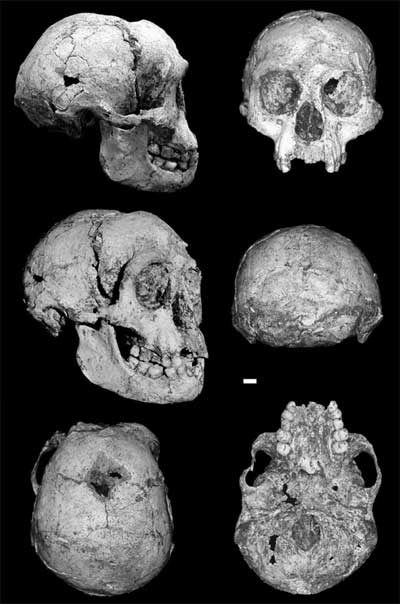
Homo Floresiensis
Found: September 2003
Where: Flores Island, Indonesia
When: 100,000 to 12,000 years ago
The face is small, specifically in facial height and has a small upper and lower jaw. The brain is also very small (380 to 420 cubic centimeters).


Reference: http://anthropology.net/2008/11/12/a-quick-review-of-novas-alien-from-earth/homo-floresiensis-2/

The skulls of our closest ancestors tell the tale of human origins and the closeness of our evolutionary history to climate change. The shapes of the hominids's skulls changed over time due to global warming. The earliest known hominids are members of the genus Australopithecus. Unlike other primates, but like hominids, their crania were small and apelike. They have been linked to the discovery of the first Homo Sapien fossils.

BOW 6 (Blog of the Week) Semester 2

How does geographic distribution of living species support evolution?
The existence of similar but unrelated species was a puzzle to Darwin. Later, he realized that similar animals in different locations were the product of different lines of evolutionary descent.
For example, the beaver and the capybara are similar species that inhabit similar environments of North America and South America. The South American coypu also shares many characteristics with the North American muskrat.

Reference: http://animals.nationalgeographic.com/animals/mammals/beaver/

Reference: http://www.rebsig.com/capybara/

Reference: http://www.animalspot.net/coypu.html

Friday, March 2, 2012

BOW 5 (Blog of the Week) Semester 2

The first living organisms to appear on earth are thought to have been anaerobic unicellular organisms, who used marine organic substances without using oxygen. Later, photosynthetic bacteria and cyanobacteria appeared in the ocean. These bacteria were able to synthesize organic substances using carbon dioxide, which causes oxygen to slowly increase in the atmosphere. Organisms later became multicellular, and eukaryotes emerged. Sponges and green algae later emerged at the end of the Precambrian age.
During the Paleozoic era, amphibians and fishes appeared and flourished in water, and ferns flourished on land. In the Mesozoic era, reptiles flourished, and gymnospermous plants dominated the ecosystem. The Cenozoic era later began when large reptiles gradually became extinct after the earth was struck by a meteorite.


Reference: http://imnh.isu.edu/exhibits/online/geo_time/geo_time_periods.htm